Hiring a marketing agency is one of the bigger supplier decisions a business makes, and one most people only make a handful of times in their career. That combination is what makes it hard. One agency pitches you organic search, another leads with paid media, a third talks mostly about brand and creative — and somehow you’re expected to compare them on the same scale.
This guide is about that comparison problem specifically. It won’t teach you SEO, or how a paid media account is structured. It’s about the buying decision itself: what different types of marketing agency actually do, how to tell a strong proposal from a merely well-designed one, and the questions worth asking before you commit a budget and a contract length to anyone.
Everything here reflects the same approach behind SEO Proposal Review, our flagship service — independent, evidence-led, and with nothing to gain from which agency you choose. SEO is where we do the deepest, paid work today, but the underlying buying problem is the same whatever the discipline.
What Are You Actually Trying to Buy?
Before comparing agencies, it helps to get specific about what you need, because “we need a marketing agency” usually isn’t a real brief. Marketing agencies specialise in genuinely different things, and a strong agency in one discipline can be a mediocre choice for a problem outside it.
A useful starting question is what changes if this works. If the answer is “more people find us through search,” you’re looking at SEO. If it’s “we need enquiries starting next month,” that’s usually paid media. If it’s “our website doesn’t reflect the business we’ve become,” that’s web design and development. If the honest answer is “we don’t really know, we just know marketing isn’t working,” that’s worth sitting with before you talk to anyone — a broader conversation with a full-service agency, or with us, is often more useful at that stage than a pitch from a specialist.
The Main Types of Marketing Agency
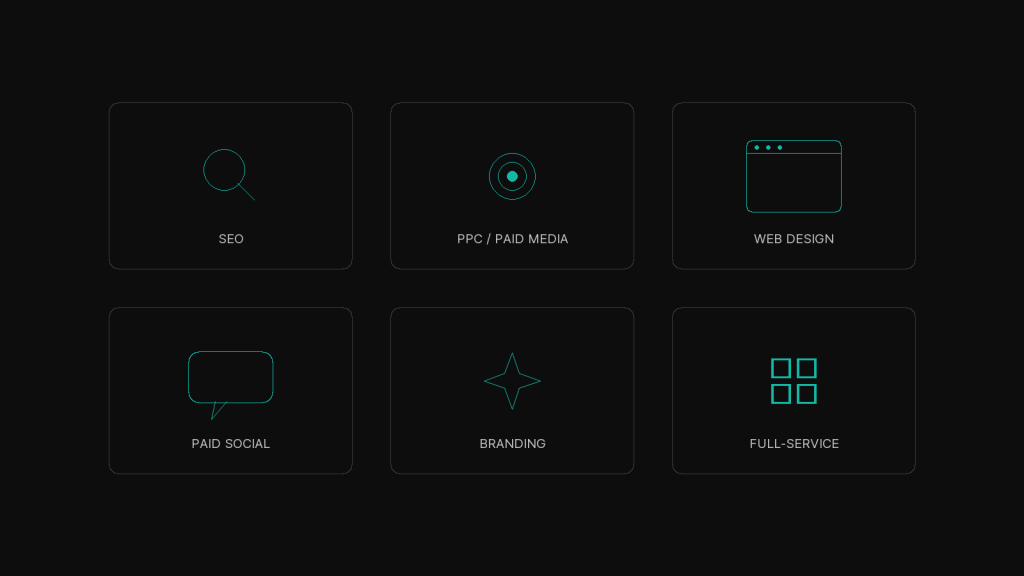
Most agencies fall into a handful of broad categories, even when their own marketing blurs the lines between them. Here’s the practical breakdown:
| Agency type | What they actually do | When you’re likely to need one |
|---|---|---|
| SEO agency | Improves how a website ranks and is found in organic search results | You want durable, compounding traffic and can commit to a 6–12 month view |
| PPC / paid media agency | Manages paid advertising spend across Google, Meta and similar platforms | You need visibility and leads on a timeline the algorithm can’t give you |
| Web design & development agency | Designs and builds the website itself | Your current site is the bottleneck, not your visibility |
| Paid social & creative agency | Builds and manages social advertising and organic content | Your audience is on social and needs reaching with creative, not search intent |
| Branding & creative agency | Defines how the business looks, sounds and is positioned | Something has changed and the business no longer looks like what it does |
| Full-service agency | Covers several of the above under one roof | You want a single point of accountability across channels |
Full-Service vs Specialist: Which Is Right for You?
Full-service agencies sell simplicity in the pitch. One contact, one contract, one team who — in theory — coordinate channels on your behalf. In practice, quality varies more across departments inside a full-service agency than it does across the market between specialists. The SEO team can be excellent while the paid media team is mediocre, and you often can’t tell until you’re several months into the relationship.
Specialists sell depth. You’re generally getting people who do one thing for a living, judged by other specialists, in a market where mediocrity gets noticed quickly. The cost is coordination — hire three specialists and someone on your side has to make sure they’re pulling in the same direction.
Neither is automatically right. As a rough guide: full-service tends to suit businesses that want one relationship to manage and don’t have the internal capacity to coordinate multiple suppliers. Specialists tend to suit businesses that already know which channel matters most right now, or that have someone in-house capable of stitching the pieces together.
How Quickly Should You Expect Results?
One of the more common frustrations in agency relationships is a mismatch between what a business expected and what the channel can realistically deliver in that timeframe. It’s worth knowing roughly what to expect before you sign, so progress gets judged fairly rather than against a timeline nobody actually promised.
- SEO — slow to start, typically three to six months before meaningful movement, and compounding after that. A short contract tends to work against you here. See our guide to how much SEO should cost for how that timeline typically maps to price.
- PPC / paid media — fast. Spend goes live and traffic appears within days; the real test is whether that traffic converts profitably, which usually takes four to eight weeks to judge properly.
- Web design & development — project-based rather than ongoing. The result is the finished site, delivered on a fixed timeline, not a monthly trend line.
- Paid social & creative — similar to paid media on ad performance, but creative testing and audience-building tend to need a few months to find what actually works.
- Branding & creative — also project-based. The output is the work itself: you either recognise the new positioning as right for the business, or you don’t.
What Separates a Strong Proposal From a Weak One
The specifics change by discipline, but the pattern in a strong proposal doesn’t. Whatever you’re being pitched, look for:
- Scope you could hand to someone else and have them understand exactly what’s being delivered — not just “ongoing optimisation” or “ongoing management.”
- Reporting tied to what the business actually cares about — leads, revenue, cost per acquisition — not only channel metrics like rankings, impressions or reach, which can improve while the business sees no benefit at all.
- Pricing that maps to a defined scope of work, rather than a monthly figure that’s never fully explained.
- Contract terms that match the risk. A long lock-in should come with a genuinely staged plan and review points, not just a lower headline price.
- Named people, not just a named agency. Ask who is actually doing the work and how long they’ve been there — churn on the account team is one of the most common reasons a good pitch turns into a disappointing year.
- Evidence relevant to a business like yours. A logo slide of famous clients tells you less than a case study from a company your size, in a comparable position.
Questions Worth Asking Before You Sign
A handful of questions tend to do a disproportionate amount of work in a first call, whatever kind of agency is across the table:
- Who specifically will be working on our account, and are they the people in this room?
- What does success look like in the first 90 days, and how will we know if it’s working?
- What happens if we want to leave — what’s the actual notice period, and what do we keep?
- Can you show us reporting from a live client, not a template?
- What’s included in this price, and what’s the first thing that would trigger an additional cost?
- Why are you recommending this approach for us specifically, rather than what you’d recommend to most clients?
Red Flags That Apply Whatever the Discipline
Some warning signs don’t depend on which type of agency is sitting across the table. Any of these is worth treating as a reason to slow down:
- Guaranteed outcomes. No one can guarantee rankings, a cost per click or a conversion rate — the honest answer to “can you guarantee this” is always some version of “no, but here’s what we’d expect based on X.”
- Case studies you can’t verify. If a result can’t be checked against the client it came from, treat it as marketing copy rather than evidence.
- Pressure to sign quickly. A good agency wants you to make a confident decision, not a fast one — urgency in the sales process is rarely matched by urgency in the delivery.
- No one senior in the room. If the person pitching won’t be the person doing the work, and no one more senior will meet you before you sign, that’s worth noting.
- A single point of failure. If the entire relationship runs through one person with no visibility for you into the wider team, ask what happens if they leave.
Where SEO Fits Into This
If the agency you’re evaluating is an SEO agency specifically, it’s worth going deeper than this guide covers. Our dedicated guide, How to Choose an SEO Agency, walks through the discipline in more detail — pricing models, the questions unique to SEO proposals, and the red flags that show up specifically in organic search pitches. And if you’re already holding two or more SEO proposals side by side, SEO Proposal Review gives you an independent, written assessment of them before you sign anything.
Frequently Asked Questions
Should I hire a full-service agency or a specialist?
It depends on whether you already know which channel matters most and whether anyone internally can coordinate multiple suppliers. If neither is true, a full-service agency generally removes more friction than it costs you in depth.
How do I compare agencies from completely different disciplines?
You usually can’t, directly — an SEO proposal and a paid media proposal are solving different problems. What you can compare is proposal quality itself: scope clarity, reporting against business outcomes, pricing transparency and contract terms, using the same checklist regardless of discipline.
Is it normal for agencies to want a long contract?
Some disciplines genuinely need time — SEO in particular is slow to show results, so a short contract can work against you. The question isn’t length on its own, but whether the length is matched by a staged plan with defined review points, rather than a lock-in with no exit.
Can I get an independent opinion on a proposal that isn’t for SEO?
SEO Proposal Review is where we’ve built the deepest process, so it’s the clearest way to see what an independent, evidence-led review actually looks like in practice. Our Digital Agency Proposal Review page covers the wider principle, and if you’re evaluating a different type of agency, get in touch and tell us what you’re looking at — we can’t promise the same turnaround, but we’re happy to have the conversation.
More on Choosing a Marketing Agency
How Much Should SEO Cost? Setup Fees and Monthly Costs
Cheap SEO vs Expensive SEO: What the Price Actually Tells You
Why SEO Pricing Varies So Much
Why Your SEO Reports Don’t Add Up (And What to Ask Instead)
What’s Missing From Most SEO Proposals?
How to Check If You’re Being Cited in AI Overviews (Without Ahrefs or SEMrush)
See What an Independent Review Looks Like
Whatever type of agency you’re evaluating, this is the same rigour we’d apply to it — independent, evidence-led, and with nothing to gain from your decision. It’s live today for SEO proposals, so this is what it looks like in practice.